Florissant, MO · Garage Door Service
Jennings homes date mostly to 1954, older than the area median, meaning original steel doors and extension-spring hardware. We drive the 6 miles from Florissant to service them.
We're based in Florissant, about 6 miles from Jennings, and maintenance calls here get scheduled the same way repair calls do - we come to you. There's no branch office in Jennings and we're not going to pretend there is. What matters more is what we find when we get there: a lot of these garages still have the door and hardware they were built with, and that changes what a "maintenance visit" actually covers.
Because the housing here runs older than a lot of the rest of the service area we cover, a maintenance visit often turns into identifying which parts are original and which have been swapped out over the decades. That's not extra work we tack on - it's the actual job. Booking ahead just means we bring the right lubricant, the right cable gauge, and the right sized rollers instead of guessing on the truck.
If you're not sure whether what you need is maintenance or repair, say what you're seeing - a door that drags, a spring that looks stretched, an opener that groans - and we'll tell you honestly which this is before we quote anything.
Most maintenance visits don't take the door out of service at all - we're lubricating rollers and hinges, checking cable tension, and tightening hardware while the door still opens and closes. The exception is when a maintenance check turns up something on borrowed time, like a fraying extension spring cable on an older setup, and we have to address it before we leave rather than come back.
Given that a good share of Jennings' garages carry the extension-spring hardware common on doors from the early 1950s, that's a real possibility here more than it would be on a newer install. We'd rather tell you that up front than have you assume a routine visit and then be surprised the door's down for an hour while we swap a cable.
The honest limitation: if the door needs a part we don't carry on the truck - an odd-length torsion tube, for instance, on a door that's been rebuilt piecemeal over the years - that's a return trip, not a same-visit fix. We won't force a mismatched part onto old hardware just to close the job in one go.
We don't publish a flat number here because what a maintenance visit costs depends on what we find, but there's one thing worth saying plainly: median household income in Jennings is $37,356, well under the $84,942 median across the wider area we serve. That gap is exactly why we lean toward maintaining and repairing what's there rather than pushing a full door replacement as the default answer.
A lot of the doors we see in Jennings are original steel panels from the 1950s build era - solid, but not something we'd tell you to rip out and replace just because a hinge is stiff. Regular lubrication and hardware checks on a door like that usually cost far less than letting a dry roller wear a track groove that then needs correcting.
Where replacement genuinely does make more sense - a spring that's stretched past safe tension, a track bent from years of the door hitting it - we'll say so instead of stretching a repair past the point it's worth doing.
Jennings' housing centers on 1954, older than the 1963 median we see across the broader service area. That decade matters for garage doors specifically: houses built then were far more likely to get extension-spring setups mounted along the horizontal track rather than the torsion springs over the header that became standard later. Extension springs stretch, fatigue, and - without a safety cable run through them - can whip if they fail.
Cold winters push that fatigue along faster. Grease left un-serviced for years thickens and stops doing its job right when temperatures drop, which is exactly the season these older setups tend to bind up or groan loudest.
Add in original steel panels that have been painted over more than once, and rollers that were never upgraded from steel to nylon, and you get the pattern we actually see on these calls: doors that still work, but that are running on 70-year-old hardware nobody's touched since it was installed.
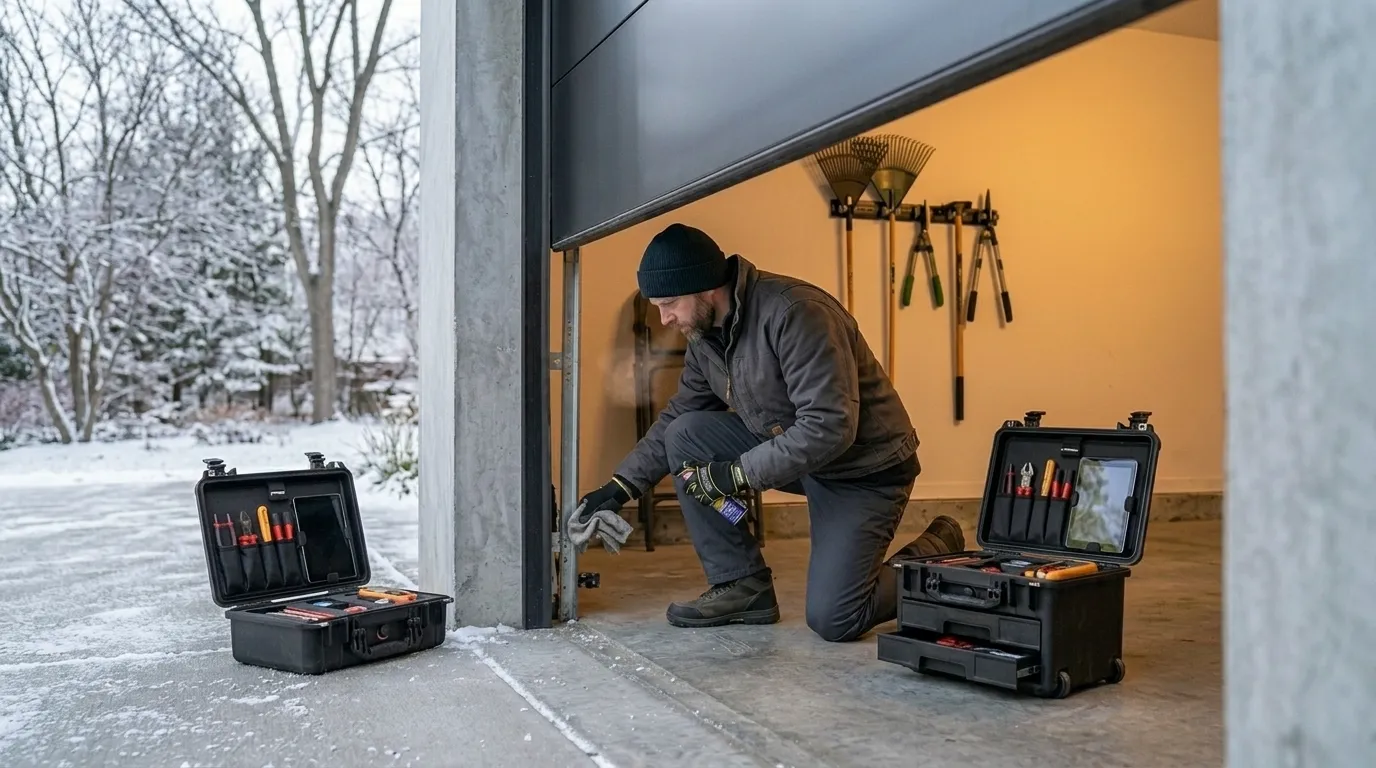
For a maintenance visit tailored to Jennings' housing age, we bring lubricant rated for cold-weather use rather than a general-purpose grease that thickens up in winter. We carry nylon roller replacements sized for older steel-track systems, since a lot of these garages still run steel rollers that have worn grooves into the track over the decades.
We also stock extension spring cables and end bearing plates, since that hardware shows up on original 1950s-era installs far more often here than it does on newer construction. What we don't carry as standard stock is a full torsion conversion kit - if a homeowner wants to move off extension springs entirely, that's a separate job we'd quote, not something we do inside a maintenance visit.
We check opener drive gears and chain tension too, since older openers retrofitted onto original doors sometimes fight geometry the door wasn't built for.
The complaint we hear most out of Jennings is a door that's gotten loud - a grinding or squealing that wasn't there a year or two ago. On a house built in the 1950s, that's almost always dry rollers or a stiffening hinge pin, not a motor problem, and it's the single clearest sign a maintenance visit is overdue rather than a repair.
The second most common thing we're called for is a door that's started sagging slightly on one side when it's down. On original extension-spring hardware, that's often one spring stretched more than its pair rather than a structural issue with the door itself.
If you're hearing either of those, catching it as maintenance is cheaper than waiting for it to become a repair call. If the door's already stuck or the spring's visibly parted, that's past maintenance - see our Jennings garage door repair page instead, or read about what maintenance covers more broadly on the Florissant maintenance page.
We'd look at it at least once a year, more if you're hearing noise or seeing a slight sag. Original hardware from the 1954 build era doesn't have the tolerances newer doors do, so small issues like a dry hinge turn into stuck doors faster than on newer installs.
No. We're based in Florissant, about 6 miles away, and drive out for every call, maintenance or repair. There's no local depot here, so scheduling ahead helps us bring the right parts for older hardware on the first trip.
Usually, yes, if the door and track are sound. A lot of what we see in Jennings is solid steel from the original build that just needs lubrication, roller swaps, and cable checks. We'll tell you plainly if a door's past the point where maintenance still makes sense.
Grease that hasn't been serviced in a while thickens in cold weather, which is when steel rollers and hinge pins on older doors start binding and grinding. It's one of the most common maintenance calls we get from this area once temperatures drop.
Call now or request a free quote - same-day service on most repairs, upfront written pricing.